Filters
Question type

Study Flashcards

An increase in taxes will shift both the consumption schedule and the saving schedule down.

A) True
B) False

Correct Answer

verifed

verified

A specific investment will be undertaken if the expected rate of return, r, exceeds the interest rate, i.

A) True
B) False

Correct Answer

verifed

verified

The numerical value of the multiplier will be smaller the


A) larger the average propensity to consume.
B) larger the slope of the saving schedule.
C) larger the slope of the consumption schedule.
D) smaller the slope of the saving schedule.

E) None of the above
F) A) and D)

Correct Answer

verifed

verified

If the MPC is 0.8, what change in investment spending is required to effect a total change in income by $60 billion?


A) $12 billion
B) $15 billion
C) $20 billion
D) $25 billion

E) B) and C)
F) A) and D)

Correct Answer

verifed

verified

A

The practical significance of the multiplier is that it


A) equates the real interest rate and the expected rate of return on investment.
B) magnifies initial changes in spending into larger changes in GDP.
C) keeps inflation within tolerable limits.
D) helps to stabilize the economy.

E) B) and D)
F) B) and C)

Correct Answer

verifed

verified

B

(Advanced analysis) Assume the following consumption schedule: C = 20 + 0.9Y, where C is consumption and Y is disposable income.At an $800 level of disposable income, the level of saving is


A) $180.
B) $740.
C) $60.
D) $18.

E) B) and D)
F) None of the above

Correct Answer

verifed

verified

Dissaving means


A) the same thing as disinvesting.
B) that households are spending more than their current incomes.
C) that saving and investment are equal.
D) that disposable income is less than zero.

E) B) and D)
F) C) and D)

Correct Answer

verifed

verified

If households consume less at each level of disposable income, they are


A) saving more.
B) saving less.
C) spending more.
D) working less.

E) None of the above
F) All of the above

Correct Answer

verifed

verified

A

If households in the economy save more of any extra income that they earn, then the multiplier effect will


A) increase.
B) decrease.
C) be unaffected.
D) become less than 1.0.

E) All of the above
F) B) and C)

Correct Answer

verifed

verified

Assume there are no investment projects that will produce an expected rate of return of 8 percent or more.There are, however, $2 billion worth of investment projects with an expected rate of return at 7 percent, and an additional $2 billion for every drop of the interest rate by 1 percent.If the real interest rate is 3 percent in this economy, the cumulative amount of investment at the 3 percent or higher rate of return is


A) $10 billion.
B) $8 billion.
C) $6 billion.
D) $4 billion.

E) None of the above
F) C) and D)

Correct Answer

verifed

verified

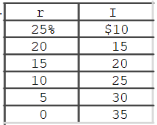
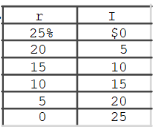
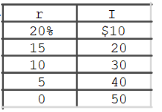
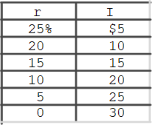
Assume there are no prospective investment projects (I) that will yield an expected rate of return (r) of 25 percent or more, but there are $5 billion of investment opportunities with an expected rate of return between 20 and 25 percent, an additional $5 billion between 15 and 20 percent, and so on.The investment demand curve for this economy is shown in which table?


A) Assume there are no prospective investment projects (I)  that will yield an expected rate of return (r)  of 25 percent or more, but there are $5 billion of investment opportunities with an expected rate of return between 20 and 25 percent, an additional $5 billion between 15 and 20 percent, and so on.The investment demand curve for this economy is shown in which table? A)    B)    C)    D)
B) Assume there are no prospective investment projects (I)  that will yield an expected rate of return (r)  of 25 percent or more, but there are $5 billion of investment opportunities with an expected rate of return between 20 and 25 percent, an additional $5 billion between 15 and 20 percent, and so on.The investment demand curve for this economy is shown in which table? A)    B)    C)    D)
C) Assume there are no prospective investment projects (I)  that will yield an expected rate of return (r)  of 25 percent or more, but there are $5 billion of investment opportunities with an expected rate of return between 20 and 25 percent, an additional $5 billion between 15 and 20 percent, and so on.The investment demand curve for this economy is shown in which table? A)    B)    C)    D)
D) Assume there are no prospective investment projects (I)  that will yield an expected rate of return (r)  of 25 percent or more, but there are $5 billion of investment opportunities with an expected rate of return between 20 and 25 percent, an additional $5 billion between 15 and 20 percent, and so on.The investment demand curve for this economy is shown in which table? A)    B)    C)    D)

E) None of the above
F) A) and B)

Correct Answer

verifed

verified

At the point where the consumption schedule intersects the 45-degree line,


A) the MPC is 1.00.
B) the APC is 1.00.
C) saving is equal to consumption.
D) the economy is in equilibrium.

E) All of the above
F) B) and C)

Correct Answer

verifed

verified

In general, the steeper the consumption schedule, the


A) smaller is the marginal propensity to consume.
B) greater is the marginal propensity to save.
C) smaller is the multiplier.
D) larger is the multiplier.

E) A) and B)
F) A) and C)

Correct Answer

verifed

verified

There are only two things that people can do with their disposable income-spend it or save it.

A) True
B) False

Correct Answer

verifed

verified

The investment demand slopes downward and to the right because lower real interest rates


A) expand consumer borrowing, making investments more profitable.
B) boost expected rates of returns on investment.
C) enable more investment projects to be undertaken profitably.
D) create tax incentives to invest.

E) A) and D)
F) None of the above

Correct Answer

verifed

verified

Suppose a family's consumption exceeds its disposable income.This means that its


A) MPC is greater than 1.
B) MPS is negative.
C) APC is greater than 1.
D) APS is positive.

E) B) and C)
F) A) and D)

Correct Answer

verifed

verified

The APC can be defined as the fraction of a


A) change in income that is not spent.
B) change in income that is spent.
C) specific level of total income that is not consumed.
D) specific level of total income that is consumed.

E) A) and B)
F) B) and D)

Correct Answer

verifed

verified

If consumers expect prices to rise and shortages to occur in the future, then there will be a shift


A) upward of both the consumption and saving schedules.
B) downward of both the consumption and saving schedules.
C) of the consumption schedule upward and of the saving schedule downward.
D) of the consumption schedule downward and the saving schedule upward.

E) B) and D)
F) A) and D)

Correct Answer

verifed

verified

Which of the following will not cause the consumption schedule to shift?


A) a sharp increase in the amount of wealth held by households
B) a change in consumer incomes
C) the expectation of a recession
D) a growing expectation that consumer durables will be in short supply

E) C) and D)
F) B) and C)

Correct Answer

verifed

verified

If the consumption schedule is a straight line, it can be concluded that the


A) APC is necessarily constant.
B) MPC is zero.
C) MPC is constant at various levels of income.
D) APC is equal to the MPC.

E) B) and C)
F) B) and D)

Correct Answer

verifed

verified

Showing 1 - 20 of 223

Related Exams

Show Answer